Free chapter · no email required
Why Your Warehouse Bill is a Scam
Chapter 1 of Local-First Analytics · 12 min read · by Mohammed Arshad Ansari
The $50K Problem
You're paying Snowflake $4,200/month. BigQuery just billed you $6,800. Your startup raised $2M and 30% of your infrastructure spend goes to a data warehouse that runs queries you could execute on the laptop sitting on your desk.
Here's what that money buys you:
- 500GB of data storage (could fit on a $60 SSD)
- ~2TB of monthly query processing
- A web UI you use twice a week
- "Enterprise-grade" features you'll never touch
- Vendor lock-in disguised as convenience
The real cost isn't the monthly bill. It's the architecture decisions you make to justify it. You:
- Split tables to minimize scans (premature optimization)
- Add caching layers because queries are "too expensive" to run twice
- Delay analytics projects because the POC would cost $800 to validate
- Hire a data engineer whose job is 40% cost optimization
This is backwards. Your data warehouse should serve your analysis, not constrain it.
What You're Actually Paying For
Cloud warehouses solve a real problem: querying petabytes of data across distributed clusters. But most companies aren't doing that.
Jordan Tigani — who built BigQuery, then started MotherDuck — looked at customer telemetry and concluded: the median data warehouse holds under 100GB, and most customers' working sets fit comfortably on a single machine. His phrase for it: "Big Data is Dead." Indie projects? Usually under 1TB. The petabyte cluster you're paying for is almost certainly not the shape of your problem.1
Counter-claim: Cloud warehouses are doing real work that local engines can't — multi-tenant concurrency, RBAC, time-travel, auto-scaling under bursty load, governance for hundreds of analysts. We agree this matters when you have 50+ concurrent BI users or compliance teams who need managed audit trails. For the audience of this book — solo builders, indie SaaS, lean data teams under ~10 people — your bottleneck is exploration speed and cost per experiment, not concurrency. The local-first stack wins there because the work has a different shape.
Let's do the math on a typical "medium-sized" analytics workload:
Data size: 200GB (compressed Parquet)
Daily ingestion: 2GB
Monthly queries: 500GB scanned
Team size: 3-10 people
Snowflake cost: ~$3,000/month ($36K/year) — Enterprise edition at ~$3/credit on-demand, mid-size workload2
Local-first cost: hardware you already own, plus a ~$400 NAS or a few dollars a month of S3 if you want offsite backup
The difference is roughly $35,000 per year. For a seed-stage startup, that's months of runway. For a side project, it's the difference between "I'll do it someday" and "I shipped it last weekend."
The Local-First Thesis
Here's the uncomfortable truth: 80% of analytics workloads don't need the cloud.
Counter-claim: The cloud isn't only about scale — it's about shared state, backup, durability, and being reachable from any device. We agree: if your team needs a single source of truth that an analyst in Berlin and an engineer in Lagos both hit at 2am, a managed warehouse handles that out of the box. Our position holds because Parquet on S3/MinIO gives you the same durability and shareability without paying per-query: cloud as backup and sync layer, not as execution engine.
Modern laptops have:
- 16-32GB RAM (enough for most aggregations)
- NVMe SSDs hitting 3-7 GB/s read speeds3
- 8+ cores for parallel processing
- Zero network latency
Modern tools have:
- DuckDB (1.5, with 1.4 LTS): in-process SQL engine that routinely beats Postgres on analytical queries45
- Parquet: columnar format that typically compresses 5–10x and supports predicate pushdown6
- Arrow: zero-copy in-memory format for passing data between tools without serialization
- Polars: DataFrame library that's commonly 5–10x faster than pandas on large analytical workloads (operation-dependent; aggregations can be far higher)7
Counter-claim: Postgres is a perfectly good analytics database for many teams, especially with columnar extensions (Citus, pg_duckdb, Hydra) or a read replica tuned for OLAP. We agree — if your stack is already Postgres, your team knows it, and your dashboards are sub-second, don't churn. Our stance holds for greenfield analytics or migrations where the warehouse layer is bleeding cash: a single-file Parquet + DuckDB pipeline is dramatically simpler than running, tuning, and replicating a Postgres instance just to do scans.
Combine them and you get: warehouse-class performance on a single machine.
Not "good enough for prototypes." Not "toy projects only." Production-grade analytics that:
- Aggregate 100M rows in a couple of seconds on a modern laptop
- Handle JOINs across 50GB Parquet datasets without breaking a sweat
- Run entirely offline (airports, trains, no internet required)
- Cost nothing except the hardware you already paid for
Who This Is For
You should read this if:
- You're a backend engineer who got handed the "data stack" and your AWS bill is terrifying
- You're building an indie SaaS and need analytics without the $5K/month trap
- You're a data engineer tired of optimizing Snowflake queries instead of answering questions
- You want full control over your data (privacy, sovereignty, portability)
- You're prototyping ML models and cloud notebooks are burning cash
You should skip this if:
- You're actually processing 100TB+ daily (use the cloud, it's built for you)
- You need real-time streaming analytics (Kafka + Flink are your friends)
- You have 50+ analysts who need a shared UI (managed BI tools make sense)
- Compliance requires cloud audit trails (though local-first + cloud backup works)
Prerequisites:
- Comfortable with Python and SQL
- Basic command line skills (can navigate directories, run scripts)
- Familiar with DataFrames (pandas/Polars) — we'll explain the rest
You don't need to be a data engineer. You don't need Kubernetes experience. If you can write a Flask app, you can build this stack.
The Stack in One Diagram
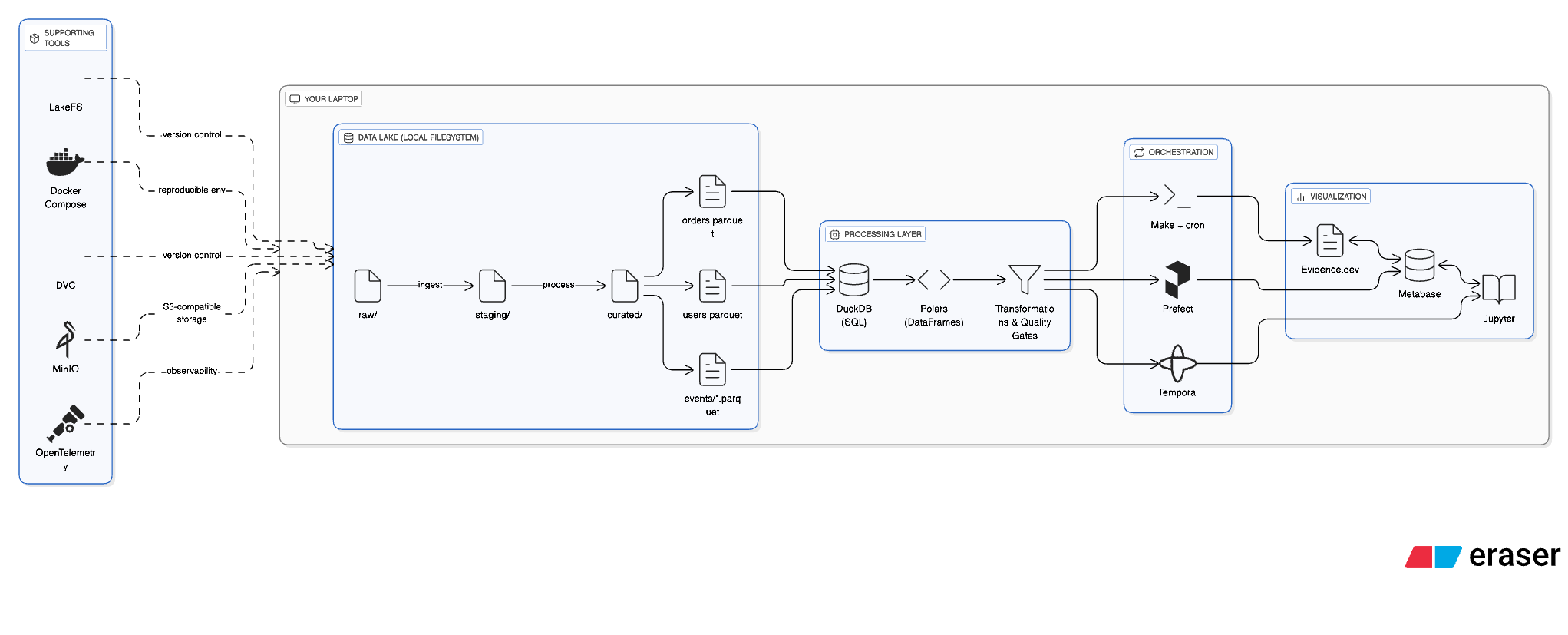
The core loop:
- Ingest data -> Save as Parquet (compressed, columnar)
- Transform with Polars or DuckDB -> Write back as Parquet
- Query with DuckDB -> Sub-second analytics on 100M rows
- Visualize with Evidence or Metabase
- Orchestrate with Make → Prefect → Dagster → Temporal (progression as you scale)
No cloud dependencies. No API rate limits. No surprise bills. Full sovereignty.
What You'll Build
By the end of this book, you'll have five working projects:
- E-commerce analytics (10M rows) — Daily sales dashboard with Make + cron — Starter‑friendly
- NYC taxi analysis (50M rows) — DuckDB partitioning and JOIN performance — Cloud‑migration proof
- Financial reconciliation — Polars transforms with data quality gates — Starter‑friendly
- Multi-source ETL — Prefect/Dagster pipeline ingesting APIs + CSVs — Cloud‑adjacent
- AI-powered logs (100M rows) — Chat interface over sensor data with Ollama — Both
Each example includes:
- Full dataset (Kaggle or public sources)
- Working code (GitHub repo)
- Docker Compose setup
- Performance benchmarks vs cloud alternatives
The Transformation Path
If you're migrating from cloud, go in order — Stages 1 through 5. If you're starting fresh, do Stage 1, skip ahead to Stage 3 (so you have a way to look at your data), and only add Stage 2 when ad-hoc scripts start hurting.
Stage 1: Replace the Warehouse
From
Snowflake $3K/month
To
DuckDB + Parquet + Arrow
Win
Comparable speed, ~$0 marginal cost, full control
Stage 2: Automate the Pipelines
From
Ad-hoc Python scripts
To
Reproducible DAGs (Prefect/Dagster)
Win
Reliability without complexity
Stage 3: Own Your BI
From
Looker/Tableau subscriptions
To
Evidence.dev + Metabase (local)
Win
Unlimited users, markdown-native
Stage 4: Add AI Without the Tax
From
OpenAI API calls on every query
To
Local LLMs + embeddings in DuckDB
Win
Privacy + no per-query costs
Stage 5: Full Sovereignty
From
Vendor lock-in, export headaches
To
Portable Parquet files + Docker
Win
Your data, your rules, forever
Why Now?
Three things converged over the last few years:
- DuckDB matured — Now at 1.5 (released March 2026), with a 1.4 LTS line ("Andium") for the conservative. Production-ready, zero-config OLAP, embedded right in your process4
- Parquet became universal — Spark, pandas, Polars, Arrow, DuckDB, every cloud warehouse: they all read and write it natively
- Laptops got fast — M-series Macs, AMD Ryzen, PCIe 4.0 NVMe drives hitting ~7 GB/s sequential reads. The economics genuinely changed3
A decade ago, you needed a cluster. Five years ago, you needed cloud credits. Today? A decent laptop and the right tools.
What This Book Is Not
This isn't:
- A DuckDB reference manual (read the docs for that)
- A defense of "never use cloud" absolutism (use what fits)
- A Parquet file format specification (we cover what matters)
- A distributed systems textbook (we're deliberately local-first)
This is:
- Practical architecture — Build real systems, not toys
- Opinionated choices — We tell you what to use and why
- Runnable examples — Every chapter has working code
- Cost-aware design — Optimize for your wallet, not cloud vendors
Next: First Query in 10 Minutes
Enough theory. Let's install three tools, download a dataset, and run a query on 10 million rows. You'll see why this stack is faster than most cloud setups — and we'll do it before your coffee gets cold.
Footnotes
-
Big Data is Dead — Jordan Tigani, MotherDuck — accessed 2026-05. ↩
-
Snowflake Pricing Options (official) — accessed 2026-05. On-demand Enterprise pricing is approximately $3/credit in US regions and varies by region and commit tier; see also CloudZero's 2026 Snowflake pricing breakdown. ↩
-
Best PCIe 4.0 SSDs 2026 — PCWorld and Tom's Hardware SSD Benchmarks Hierarchy — accessed 2026-05. Top consumer PCIe 4.0 drives (e.g., Samsung 990 Pro) hit ~7.0–7.45 GB/s sequential read. ↩ ↩2
-
Announcing DuckDB 1.5.0 — DuckDB Blog (March 9, 2026) and Announcing DuckDB 1.4.0 LTS — accessed 2026-05. ↩ ↩2
-
DuckDB vs Postgres for embedded analytics — MotherDuck — accessed 2026-05. Independent benchmarks show 16–26x speedups on typical OLAP queries; Postgres still wins on concurrent OLTP. ↩
-
Parquet vs CSV — Last9 and Parquet compression techniques — Dremio — accessed 2026-05. 5–10x vs CSV is typical; DuckDB TPC-H SF20 shows 5x (3.2 GB Parquet vs 16 GB CSV). ↩
-
Polars vs Pandas independent speed comparison — Towards Data Science — accessed 2026-05. Filtering 2.6–10x faster; aggregations have been measured at 20x+; group-by typically 2–5x. ↩
That was chapter 1 of 12
The rest builds the stack layer by layer: the first query in ten minutes, Parquet and Arrow internals, partitioning that survives real data, DuckDB as your warehouse, Polars transforms, quality gates, orchestration, BI without per-seat pricing, and local AI over your own files. 313 pages, with runnable code for every chapter.
And if the chapter describes your stack a little too well: the $3,000 audit is where I look at it with you.